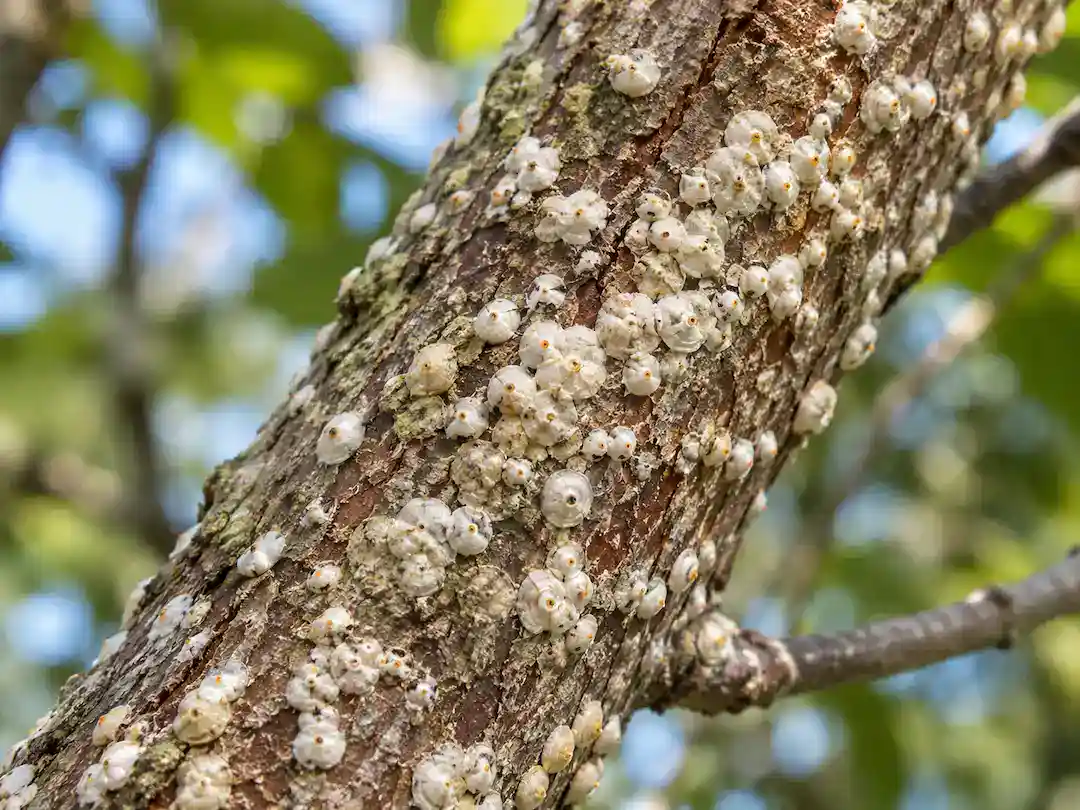
Most tree pests announce themselves. Scale insects do the opposite. They disguise themselves as harmless bumps on bark and branches, hold perfectly still, and quietly drain sap for months before anyone notices the tree thinning out. By the time the sidewalk under a tree turns sticky, or the trunk goes black with mold, scale insects on trees have usually had a full season’s head start.
BroadLeaf Tree & Shrub has treated scale on ornamental trees and shrubs across the Triangle since 2018, and our office sits in Research Triangle Park, where we see scale problems regularly. This guide covers how to identify the scale species common in Durham and RTP, why our landscapes suit them so well, and how to prevent or treat an infestation.
Table of Contents
What Are Scale Insects?

Scale insects are small sap-sucking insects that attach themselves to bark, twigs, and leaves, then feed in one spot for most of their lives. Adult females have no visible legs, wings, or antennae, so they look more like bumps, shells, or bits of wax than insects. That camouflage is exactly why infestations build unnoticed.
They belong to the same order of true bugs as aphids, and like aphids, they feed by piercing plant tissue and drawing fluids out of the vascular tissue underneath. One scale does trivial damage. Thousands of them, which is what an unchecked scale infestation becomes, rob a tree of the nutrients and water it needs to grow and defend itself.
Armored Scales vs Soft Scales
Every treatment decision starts with one question: are you dealing with armored scales or soft scales? The two groups look different, behave differently, and respond to different controls.
| Armored scales | Soft scales |
|---|---|---|
Size | 1/8 to 1/4 inch | 1/4 to 1/2 inch |
Covering | Hard, waxy armor detached from the body | Smooth or cottony waxy substance that is part of the body |
Honeydew | None | Large amounts of sticky honeydew |
Eggs per female | Up to about 50 per season | 1,000 to 2,000 per year |
Common examples | Euonymus scale, pine needle scale, oystershell scale, San Jose scale | Magnolia scale, tuliptree scale, lecanium scale, cottony maple scale, pine tortoise scale |
The honeydew difference matters most for diagnosis. Soft scales excrete the sugary liquid as they feed, which coats leaves, branches, and parked cars below, then grows a black fungus called sooty mold and attracts ants. A blackened, sticky tree almost always means soft scales. Armored scales don’t produce honeydew, so heavy infestations can go completely unseen until branch dieback starts.
The egg numbers explain why soft scale problems escalate so fast. When a single adult female can produce a couple thousand eggs, a light infestation one summer can be a crisis the next.
Common Scale Insects on Triangle Trees and Shrubs
A few scale species account for most of the calls we get in Durham, Raleigh, and RTP:
Crape myrtle bark scale. White felt patches on crape myrtle trunks plus heavy sooty mold. This invasive pest has spread quickly through the Triangle, and we cover it in depth in our guide to crape myrtle bark scale treatment.
Lecanium scale. Brown, helmet-shaped bumps on oaks, maples, and other shade trees, often first noticed as honeydew dripping onto driveways.
Gloomy scale. An armored scale that blends almost perfectly into red maple bark and thrives on hot, paved sites.
Magnolia scale and tulip tree scale. Two of the largest soft scales in North America, both capable of covering magnolia and tulip poplar branches in waxy clusters.
Euonymus scale. Attacks euonymus and related ornamental shrubs, with white males speckling the leaves.
Azalea bark scale. Cottony masses in azalea branch forks, a staple shrub in nearly every Triangle foundation planting.
Pine needle scale and spruce bud scale. The conifer specialists, showing up on pines, spruces, and the dwarf Alberta spruce by many front doors.
Each species keeps its own calendar, which becomes important the moment you try to treat one.
Signs of Scale Insects on Trees
Look for these signs, starting on twigs, branch undersides, and the junctions where branches meet:
Bumps, shells, or cottony patches that do not belong on smooth bark
Yellowing, wilting, or undersized leaves on affected branches
Sticky honeydew on leaves, bark, or anything beneath the tree
Black sooty mold coating trunks, foliage, or hardscapes
Ant trails running up the trunk, since ants farm honeydew
Canopy thinning and branch dieback that worsens year over year
To confirm scales are alive, flick a few bumps off with a fingernail and crush them. Live scales smear and leave moisture behind. Dry, hollow shells mean old scale coverings, which can cling to bark long after the insects are dead, and they sometimes fool property owners into treating a problem that is already resolved.
The Scale Life Cycle, and Why Timing Decides Treatment
For most of their life cycle, scale insects are nearly impossible to kill. Adult females sit under their protective covering, lay their eggs beneath it, and die in place. The waxy armor sheds sprays, which is why you can treat a tree twice and see no change.

The exception is the crawler stage. When eggs hatch, the young crawlers walk out from under the covering to find their own feeding sites. For a few weeks, they are exposed and vulnerable. Nearly every effective contact treatment aims at crawler emergence, and nearly every failed treatment missed it.
Crawler emergence varies by species, which is one more reason identification comes first. Many Triangle species produce crawlers between April and July; some have a second generation in late summer, and a few hatch at odd times entirely. Arborists track the window by wrapping infested branches with double-sided sticky tape and checking for yellow or orange specks, which mean crawlers are active.
Why RTP and Durham Landscapes Are Prone to Scale
Scale insects thrive in the Research Triangle Park, and it is not bad luck. Research Triangle Park and the neighborhoods around it stack several risk factors on top of each other:
Heat and pavement. Scales thrive on warm, dusty trees. NC State research on urban red maples links hot, paved sites to dramatically higher scale densities than shaded or forested ones, and RTP is a landscape of parking lots, street trees, and office park islands.
Stressed host plants. Compacted clay soil, construction damage, and summer drought leave trees with fewer resources to resist sap-feeding insects. A stressed tree is an easy host.
Repetitive plantings. Commercial sites tend to plant the same ornamentals in rows: crape myrtles, hollies, azaleas, maples. When scale reaches one plant, the rest of the row is a short crawl away, and infested nursery stock introduces new scale populations every planting season.
Mild winters. Our winters rarely get cold enough to knock scale populations back the way harsher climates do.
Fewer natural enemies. Lady beetles and small parasitic wasps normally keep scale in check. Insecticides commonly used on trees and shrubs kill these beneficial insects faster than they kill the armored pests they hunt, and scale populations explode in the gap.
How to Prevent Scale Insects on Trees
Prevention is mostly a matter of keeping trees unattractive to scale and keeping their predators alive:
Keep trees vigorous. Deep watering in dry spells, a proper mulch ring, and good planting practices prevent scale better than any spray.
Go easy on nitrogen. Nitrogen-rich fertilizers push soft, sappy growth that sap-sucking insects favor. Lawn fertilizer reaching a tree’s root zone counts.
Inspect before you plant. Check new plants for bumps, felt patches, or sticky residue before they come home. One infested plant can infest a whole property.
Protect beneficial insects. Skip routine broad-spectrum sprays so lady beetles and parasitic wasps can do their job.
Inspect your trees each season. Scales found while populations are small are an easy fix. Our overview of common tree pests in urban areas covers what else to look for on the same walk.
How to Treat Existing Scale Insects on Trees
Identify the species first. Armored and soft scales respond differently, so the species sets the treatment window.
Prune out the worst branches. Removing heavily infested limbs takes thousands of scales off the tree at once. Our tree pruning crew pairs this with infestation mapping so the cuts target the problem, not the tree’s structure.
Apply horticultural oil at crawler emergence. Oil smothers crawlers and settled young scales without the residue that harms beneficial insects. Coverage has to be thorough to work.
Use dormant oil in late winter. A dormant season application smothers many overwintering armored and soft scales before the growing season starts.
Consider soil-applied systemic insecticides for serious soft scale infestations. The tree carries the product to the feeding insects, giving season-long control that sprays cannot. Systemics are less reliable against armored scales, and on flowering plants they require care around pollinators, so follow label instructions exactly or leave the application to a licensed professional.
Reserve rubbing alcohol for small plants. Dabbing scales with alcohol on a cotton swab works on a houseplant or a small shrub. On a tree, it is not a realistic option.
Dead scales stay glued to the bark, so judge success by crushing a sample and by sticky tape counts the following season, not by whether the bumps disappear.
When to Call an Arborist
Some scale situations are beyond a garden hose and a bottle of oil. Call a professional when the tree is too large to spray thoroughly, when sooty mold or honeydew covers a large area, when branch dieback has started, or when the same plants get reinfested year after year. Repeated infestations usually mean an underlying stress or timing problem that products alone will not fix.

BroadLeaf’s plant health care program is built for exactly this: certified arborists who identify the species, monitor crawler emergence, time treatments correctly, and address the soil and stress conditions that invited scale in the first place.
We serve homeowners and business owners throughout Durham, RTP, Raleigh, Apex, Cary, Chapel Hill, and the surrounding Triangle area. Call (919) 632-3565 or use the form below to request a consultation. Your on-site consultation fee is credited toward any service you book.
Frequently Asked Questions
How do I get rid of scale insects on trees?
Identify whether they are armored or soft scales, then prune out heavily infested branches. Apply horticultural oil when crawlers are active, use dormant oil in late winter, and consider a soil applied systemic insecticide for severe soft scale infestations. Timing treatments to crawler emergence matters more than the product you choose.
What does a scale infestation look like?
Look for small bumps, shells, or cottony patches fixed to bark, twigs, and leaf undersides, along with yellowing leaves and thinning branches. Soft scales also leave sticky honeydew and black sooty mold on the tree and anything under it, and ant trails on the trunk are a common giveaway.
What is the best spray for tree scale?
Professional-grade horticultural oil is the most reliable spray for most scale insects because it smothers crawlers and young scales while sparing beneficial insects. Dormant oil applied in late winter controls overwintering stages. No spray works well against mature armored scales, which is why application timing matters.
Can rubbing alcohol kill scale insects?
Yes, rubbing alcohol dabbed directly onto scales with a cotton swab kills them on contact, and it is a practical option for houseplants and small ornamental shrubs. It is not realistic for trees, where thousands of scales hide across bark you cannot reach or even see.
Will scale insects kill my tree?
They can, though it usually takes time. Heavy infestations drain nutrients, thin the canopy, and cause branch dieback, and the ongoing stress opens the door to borers and disease that finish the job. Trees treated early, with crawler-stage timing, typically recover fully within a season or two.